

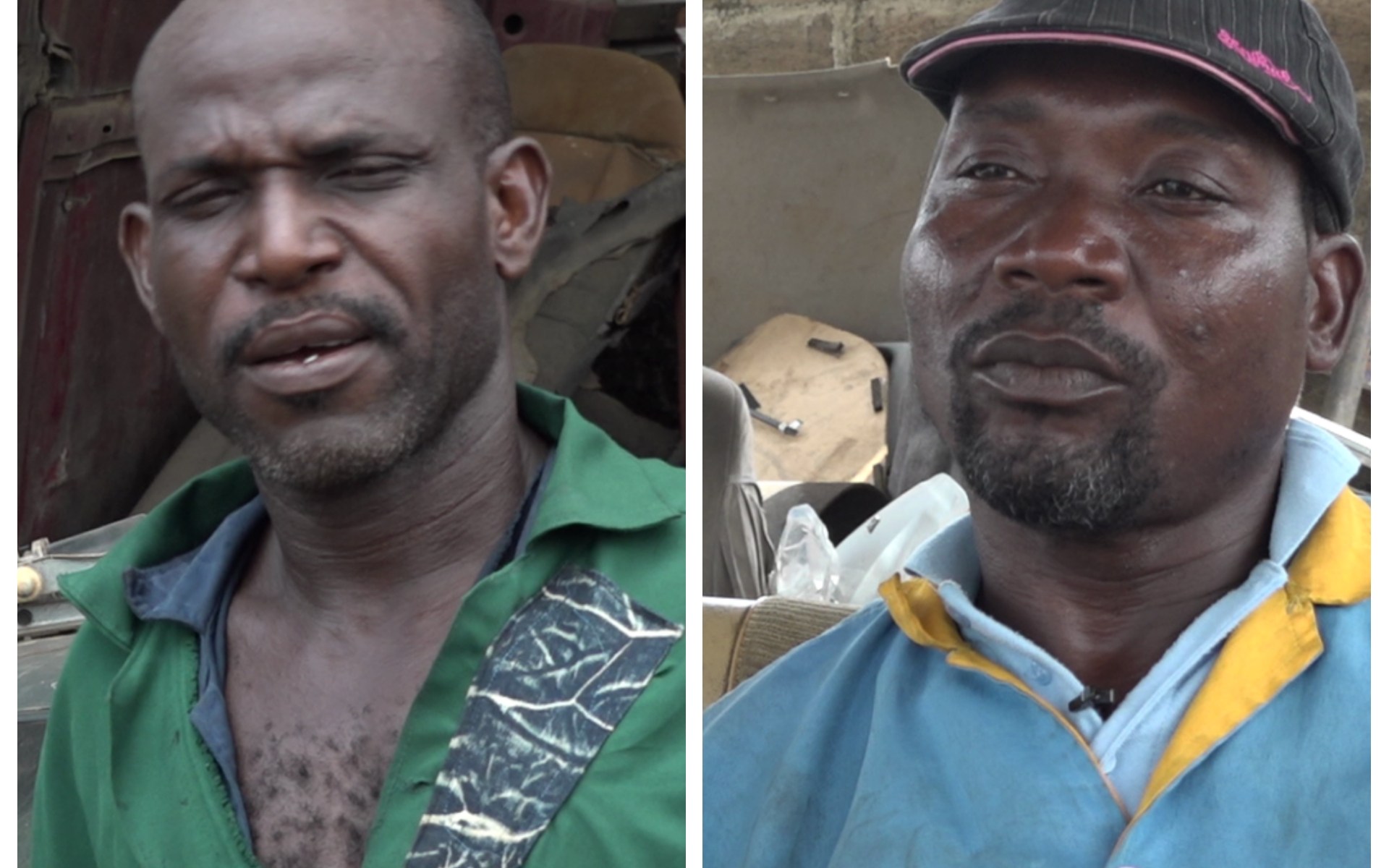
Mechanic, that is what the automobile repair man is popularly called in Nigeria.
The land mass or space they occupy to ply their trade is what is commonly known, in Nigeria, as the Mechanic Village.
But who is the mechanic man and what is the personality behind that, often Dirty apparel they put on? Many of them were not educated in the four walls of western education but they still get by and get their messages across to their customers.
OMOLADE OYEPATA
Omolade Oyepata is the head of one of the Mechanic Workshops at the Kurata Village at Ogba and he specializes in car repairs. He has been in the business of automobile repairs for the past 33 years. He got his training in Ikare Akoko, Ondo State. He attended Technical school, Owo. His proficiency in the Practical aspect of his studies at the Technical School inspired his father to persuade him to learn more about automobile repairs upon which he took young Oyepata to a seasoned Panel Beater called Ade. “Ade is a mechanic, a Panel Beater and an all-round automobile Engineer. My father wanted me to have all those experiences so that it would be useful to me in future. I trained under Ade for eight years…” After his apprentice years under Ade in Ondo, Oyepata came to Lagos to continue further training on the job under one Mr. Murili, who is now a Pastor. “He loved the way I work and so he handed over the whole workshop to me and told me to manage the place for him.”
Immediately after his training under Murili, Oyepata believed he was proficient enough to set up his own Workshop. Murili was so impressed with Oyepata that he was hesitant to release his dutiful Trainee. “I stayed with him for three years. He so liked my work that he didn’t want me to leave his place. It was a tug of war at the time. He even accused me of wanting to take all his Clients.” Since, he had made up his mind not to serve any man for life, he made the decision to leave Murili’s workshop to be his own boss.
Seven years into his Training as an automobile repair man, Oyepata got married. With three out of his five children in Universities in Nigeria (one of them is Reading Petroleum Engineering in one of the State Universities), his desperation to ensure none of his kids end up without Western education as he did is what continues to push him to do everything legitimately possible to educate his children.
Contrary to the perception that automobile repair business known in popular Nigerian parlance as Mechanic is an indecent job for dropouts, Oyepata says it is a good business. “ If young people can calm down and concentrate on this job with all sense of sincerity and honesty, I am sure they will make it in this business. Trust is key here. Let your A be A, your B be B. When you quote for an original spare part don’t go buying fake or Tokunbo Parts. Tokunbo Parts is a fairly used part and not a new Part. That is why 85% of what I use comes from new motor Parts…” This is what has endeared him to his corporate Clientele who believe in his job and professional judgement.
Lubricants is one major liquid that features more in every mechanic workshop. They come in different brands and quality. Oyepata says he trusts only one of them. That brand is Mobil Oil. Due to the rampant nature of the adulteration of Oil in the market, Oyepata goes to the direct source to procure his consignments. “For me to get the real one, I go to the fuel station myself to get a carton or more and sometimes they bring it, direct from Mobil, to me because they know I service cars very often. So, I prefer to patronize the Mobil Oil.”
However, he didn’t start out to use the Mobil Products. According to him, his Master’s brand at the time was ConOil. “Please don’t get me wrong most of these Oil brands are good and I have tested virtually all of them. Some of these Oil products dry up when you pour them in the car and if care is nit taken would knock your Engine. This is true, particularly in the case of Car Owners who don’t service their cars as at when due. Or, worse still, for those who are penny wise, pound foolish who prefer cheap Oil. So, over years of working with these different brands, I discovered that Mobil Oil is more effective than most of them.”
A common feature in most Mechanic Workshops is the fact that the floor of the shop and its general environment, often times, is soaked with used Oil drained from cars under repairs or servicing. But it is a different scenario in Oyepata’s shop. “It is true we used to drain Oil and spoil the floor of our workshop with the drained lubricant. We discovered that soaking the floor with the used oil makes our environment dirty. So, why pouring on the floor when you know you are still going lie on it when you are working under a car or even just to lie down and rest.”
In the last three years, a new trend emerged in which the Workshop Apprentices sell off the condemned drained oil to people Oyepata cannot really identify. “Each time we ask our Apprentices to throw away the drained Oil, some people come to meet with them to buy the Oil. So, they sell it off to those people and since it is Oil we are not using anymore, we allow the Trainees to sell it.”
Still on the lubricants, in the absence of his favorite brand, Oyepata lists his second and third options when looking for Oil to service cars under his repair. For Oyepata, it is not just about options. “Each of these Lubricants have their different usage and values. Mobil Oil, for instance, is very light. ConOil or Total (that is treated) we use for big buses. Please don’t get me wrong, I am not saying Mobil Oil is good for all vehicles. There are certain vehicles we cannot use Mobil Oil to service. We are able to determine this by first looking at the capacity of the car.” Engineer Omolade’s love for the Mobil Oil brand goes way back in time. “There was a time a client came to my shop and brought some kind of Oil for me to use to service his car. I told him that Oil is bad and would not work for his car and that he should use Mobil Oil. But he rejected my counsel and went ahead. As I predicted his car developed issues arising from the use of the Oil he insisted on using. It was unfortunate that a fellow mechanic recommended that Oil to him. Anyway, the man who introduced him to me told him to return to my shop if he wanted his car fixed. He brought the car. First, I had to change that Oil, then get a good Oil Filter because there are different and fake Filters around which are capable of knocking car engines. I applied the Oil I had told him to use from the outset, fixed a few damaged parts in the engine and today, his car is back as new… with a renewed life span of over ten years.” To avoid being sold fake or adulterated Oil, Oyepata advises car Owners to go to the filling stations to purchase their lubricant Oil.
ABDULLAHI AREMU
Abdullahi Aremu is the head of One Love Mechanic workshop also in Kurata mechanic village. He is a Panel Beater with over 20 years’ experience. He began his training as Panel Beater with Wasiu and Wasiu at Fadeyi Aladura street at Ikeja. Prior to his practical experience, Abdullahi had done the theoretical aspect of his apprenticeship in an automobile repair workshop at Ojota which took him six years of training. Since 1991, he has been on his own till date.
As one who has been in the business for decades, Engineer Aremu believes the profession is not accorded the respect it deserves by the government. “The State government does not give us the recognition that we ought to be accorded. They see us an unserious set of people. When you go to the bank and seek for a job, for instance, they would ask if you have a wife and children. If you say yes, they will give you the job. But if you tell them that you are not really a family man in the true sense of the word, you automatically lose the job because they would have the impression you are not responsible enough. In other words, if you have don’t have confidence in what you do, you would lose it or leave it at any time. But if you are confident in what you do regardless of the challenges, you will excel in it.”
According to Aremu, most of the commercial vehicle Drivers today are mostly Automobile Repair men who dumped the job for public bus driving. “It is due to the lack of rest of mind they had while doing the job of the Mechanic. It is either Local Government Tax authorities or Environmental Agencies are chasing them or Landgrabbers, popularly known as Omo onile are harassing them for all sorts of extortions. So, you find the mechanic man moving from one place to the other and this affects him financially, emotionally and psychologically. But I decided to stand and weather the storm. I know how many years of torment it has taken me to be where I am today. I have children in the University of Ibadan, two are currently doing their exams to enter university. If you are content with what you have, you would be ok. Abacha’s government was more than this, yet we survived it.”
An incurable optimist with a resilient spirit, Aremu says no matter how hard the storm, it would always blow over for a new dawn. “ The God of yesterday is still the same God today. If you know He is the one you are serving, sincerely, you will be confident that the hard times will always end. If you say, ah, Lagos is too hard and you want to move to Ibadan, do you know what fate awaits you there? Many of my colleagues who left the job and travelled to foreign Lands in search of the greener pastures always come back home with nothing. When they return, they still come to us for financial assistance. Look at what is happening to Nigerians in Libya, Sierra Leone and other foreign countries…I called a friend of mine who is in one of the countries to find out how he is faring in that foreign land and he told me he is not finding life easy over there. We always warned them before they proceed on those journeys but they never listened to wise counsel. As I speak with you, that friend of mine is looking for money to come back home.”
Aremu he gets some of his tools of work such as carbide among others in Nigeria but they are mostly imported materials. Essentially, the seasoned Panel Beater says his job goes beyond Panel Beating. He actually specializes in ‘accidented vehicles.” In other words, he puts together and make whole a car that has been destroyed into bits from its accidented state.
For one who deals with a highly combustible chemical as gas, what safety precautions does he observe to safeguard lives and properties in his workshop when working on cars? “I don’t joke with safety principles around here when working. I always have first aid kits in the shop and whenever I want to work with gas, I always instruct my boys to take the necessary precautions such as tightening the gas hose to avoid leakages. When you are welding, you must concentrate and as much as is possible avoid distractions. Sometimes the hose does experience minor leakage and when that happens we quickly rectify the fault. So, I lock the gas and open the hose to allow for the hidden gas in the hose to escape. We can do that because we apply full focus on what we are doing. However, some people who are not so experienced and who are easily distracted may not be aware of this technique and so explosion may occur which can be catastrophic” But he is grateful to God that no such incidence has ever occurred since he started out on his own.
It does seem that many Nigerian welder mechanics do not have a particular position the gas cylinder must be to supply gas for their welding activity. But Aremu says the position of the cylinder matters in terms of safety. “I don’t like to have my cylinder standing. It is dangerous to leave in that position because if it falls down and breaks the valve, it could lead to explosion and that could be disastrous. My carbide tank was imported from Cotonou and it is a double tank equipment. You can imagine what would happen should it explode. That is why I ensure my cylinder is never in a vertical position.”
Abdullahi’s choice of tank is deliberate because he does not believe in compromising quality in the execution of his job. For him, it is, largely, a Nigerian thing to compromise especially among most welders who love to cut corners.
The Oyepatas and Abdullahis of the Nigerian automobile repair community may not be fluent in spoken English, they may not look responsible at first glance but a closer view of their personalities, as you have seen in this episode, would reveal the highly responsible and organized life they live and the dexterity and professionalism they bring to bear on their business. What is more heartwarming, is the fact that these men are more patriotic than most educated and blue collar working class Nigerians. All they need is a refinement of the processes and principles guiding the execution of their profession in the country and they would be more productive to the State and their neighborhood of operations. All they need is that all important government recognition and support by government and all would be well with the mechanic and the community in which he plies his trade.


 Energy Network